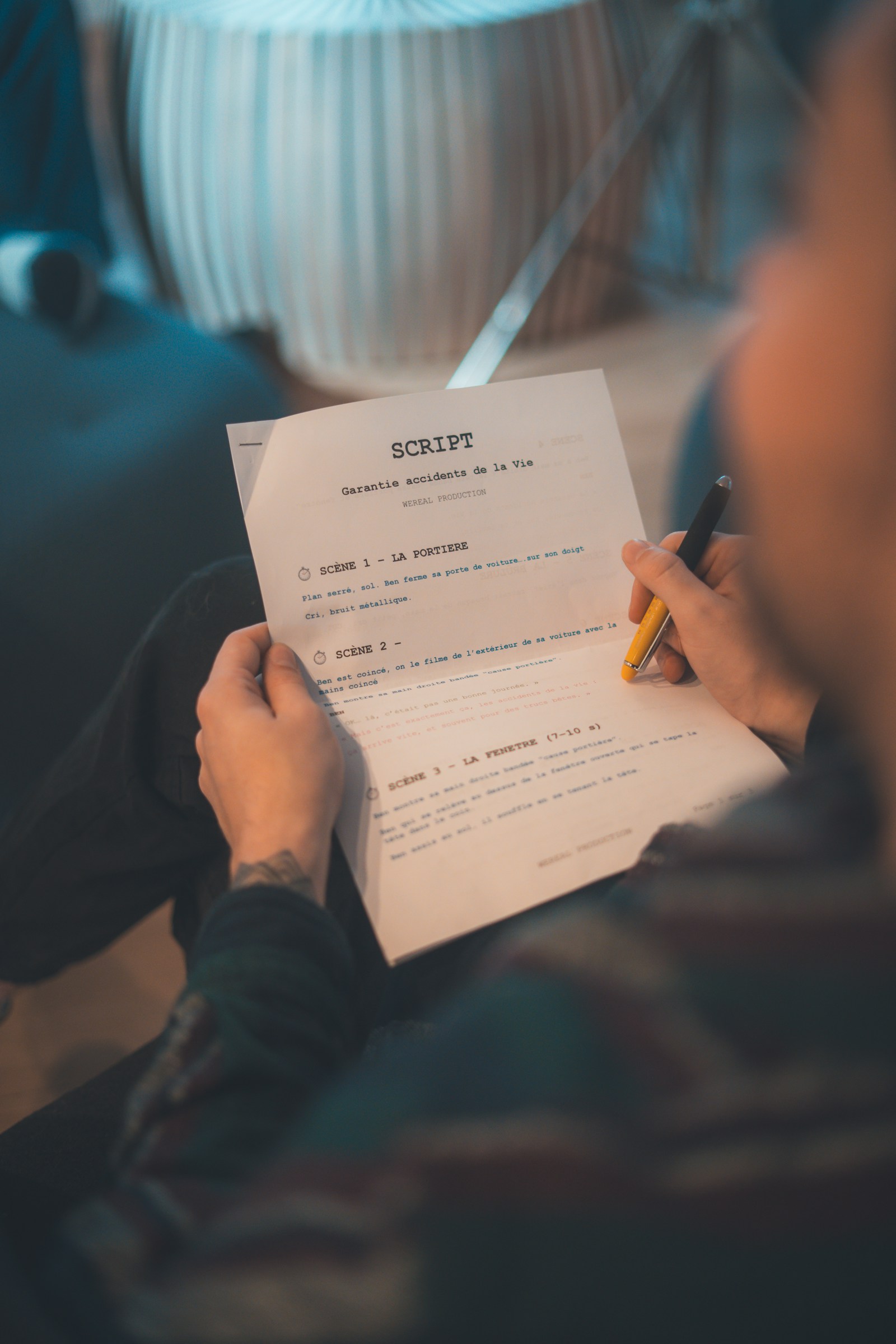
How to Rehearse Audition Sides Alone Without Losing the Scene
6/30/2026
Rehearsing alone gives you time and privacy, but it also creates a trap: you can become very good at saying your lines in one predetermined way.
A scene is not a sequence of polished speeches. It is a changing exchange. Even when no scene partner is available, your rehearsal should leave room for listening, surprise, and adjustment.
The goal is to arrive at the self-tape prepared but still responsive.
Begin with the whole scene
Read the sides once without performing. Include the other characters' dialogue, action lines, and any information at the top of the page.
Then answer a few practical questions:
- What has happened immediately before the scene?
- What does your character need from the other person?
- Why do they need it now?
- What is making that difficult?
- What changes before the scene ends?
Keep the answers playable. “I want her to admit she lied” gives you something to pursue. “This scene demonstrates my character's abandonment issues” may be accurate, but it does not tell you what to do to the other person.
Divide the scene into changes, not line counts
Look for moments when new information arrives, a tactic fails, the balance of power shifts, or your character makes a decision. These are beats.
Mark them lightly. Avoid planning a different facial expression for each beat. The mark is there to remind you that the conversation changes, not to prescribe exactly how the change must look.
For each section, choose a simple action toward the other character:
- Reassure them
- Corner them
- Charm them
- Get them to stay
- Make them feel guilty
- Hide what you know
Actions keep attention outside yourself, which is especially helpful when rehearsing without another actor.
Learn the thought before fixing the delivery
Memorisation becomes brittle when you attach every word to one rhythm too early. Learn why one thought leads to the next before deciding precisely how the line should sound.
Try paraphrasing each section in your own words. Then return to the text. If you understand the thought, the exact dialogue has somewhere to live.
You can also write the first letter of every word, cover the page progressively, or test yourself from different starting points. Starting only from the top can create a chain in which forgetting one line destroys everything after it.
Use the other character's lines as events
Your cue is not merely the final word before your dialogue. Something has been said to you.
Before responding, identify what the line does:
- Is it an accusation?
- A refusal?
- An invitation?
- A lie you recognise?
- Information you did not expect?
When you rehearse with an AI reader, let the reader's line affect you before you speak. Do not race to prove that you know the next line. A responsive reader mode can follow your delivery, so you do not need to force every pause into a fixed prerecorded gap.
Change one condition on each pass
Running the scene identically ten times may improve fluency while reducing discovery. Give each rehearsal pass a different purpose.
For example:
- Clarity pass: understand every thought and reference.
- Listening pass: place all attention on the other character's lines.
- Urgency pass: explore why this conversation has to happen now.
- Opposite pass: try a less obvious choice, such as hiding anger rather than displaying it.
- Stillness pass: remove unnecessary movement and see what remains.
- Camera pass: record and review the scene at the intended framing.
You are not trying to create six finished versions. You are widening the range of available responses before choosing what serves the scene.
Direct the reader only where it helps you
If the reader's delivery makes a moment difficult to play, adjust it. A line might need to arrive faster, carry more suspicion, or sound as though the character is trying to conceal concern.
Keep the direction short and behavioural:
- “Trying to sound casual, but worried underneath”
- “Impatient, interrupting the thought”
- “Genuinely surprised, then covering it”
Do not direct every line. Too many changes can make the scene feel assembled one sentence at a time. Focus on turns, reveals, jokes, and moments where the relationship changes.
Record before you feel completely ready
Actors often wait too long before seeing the scene on camera. Record an early rehearsal take. You are not judging whether it is submission-ready; you are checking whether the internal work is visible and whether the technical setup supports it.
Watch once without sound. Are your eyeline and framing steady? Is physical tension distracting from the scene?
Listen once without watching. Are the thoughts clear? Does every line have the same rhythm? Are you responding or reciting?
Then choose one adjustment. Trying to repair six things in the next take usually makes the acting more self-conscious.
Leave something alive for the take
Preparation should make you available, not fixed. Know the text, the circumstances, and what you are pursuing. Then allow the reader's line to land differently.
Even an AI reader can help you practise this. Change the reader voice, adjust a key acting direction, or begin from the middle of the scene. Small variations prevent your response from becoming automatic.
The final self-tape does not need to display all the work you did. It only needs to show a person thinking, listening, and trying to affect someone else.