
He gets a job title. She gets a family role.
10/1/2026
He’s an architect. She’s somebody’s wife. If you spend enough time reading casting notices, you might start wondering why his introduction sounds like a résumé and hers sounds like a family tree.
So we counted.
At Self-Tape Studio, we reviewed 195 acting roles across 95 US productions advertised on Backstage. Each role’s casting age range included 40 or 50. We asked a simple question: does the description mention the character’s job, their family or romantic relationships, both, or neither?
Male roles more often came with a job and no relationship mentioned. Female roles more often came with a relationship and no job mentioned.
A different slice of life
Almost half the male roles (47%) mentioned a job without mentioning family or romance. For female roles, that figure was 31%.
35% of female roles mentioned family or romance without a job, compared with 24% of male roles.
The infographic shows all four categories. The pies are the same size so you can compare the proportions, even though the sample contains more male roles.
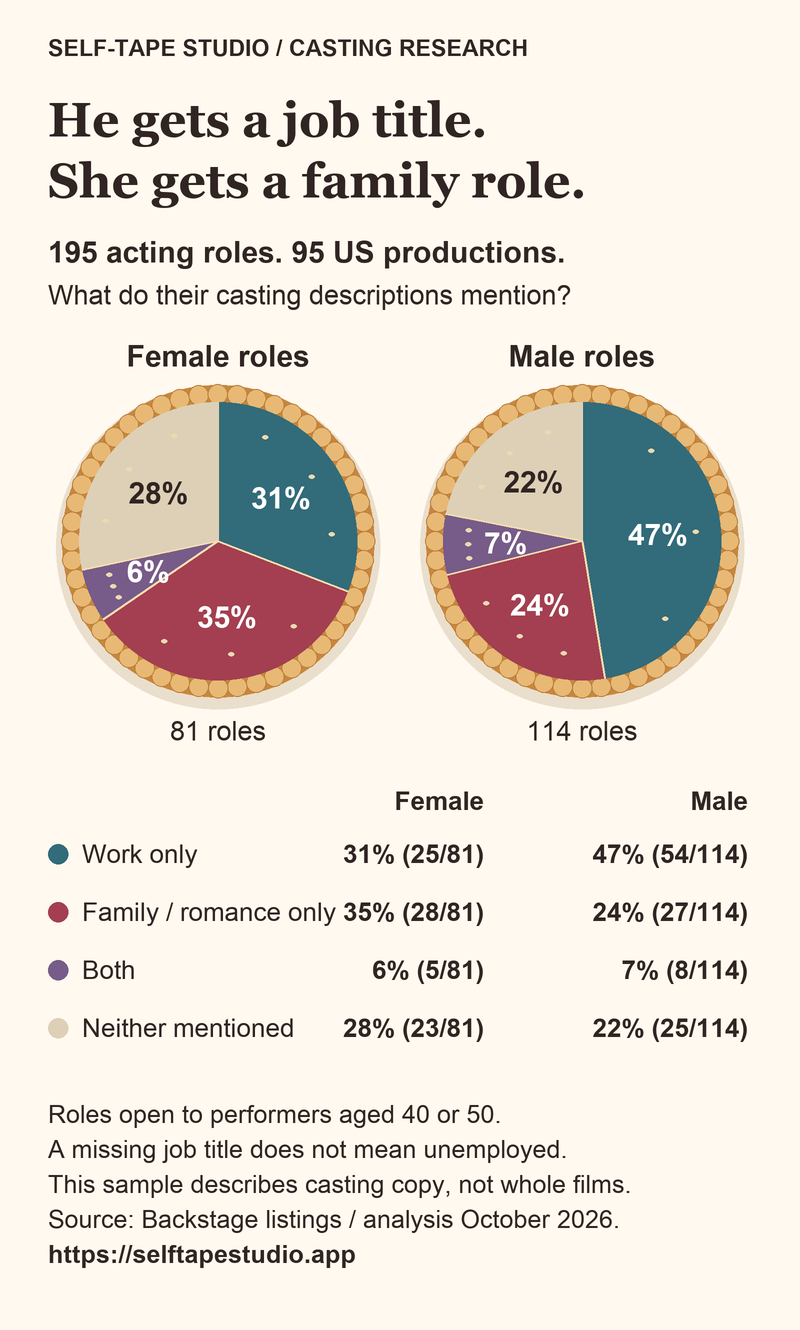
View the full-size infographic. Based on 81 female roles and 114 male roles. “Family or romance” includes relatives, spouses and romantic partners. Percentages are rounded. The charts measure what the descriptions mention.
Four job titles and a deceased wife
One listing caught our attention. Crazy Zenzot’s Big Bang advertised a police captain, a professor, a police officer and a sergeant. All four were male roles open to a performer aged 40.
Also open at that age: Elena, the hero’s deceased wife.
These were some of the advertised parts, not the entire cast. The men’s descriptions give them occupations. Elena’s identifies her through her relationship to the hero.
We also compared male and female roles within the same productions, giving each production equal weight. The pattern remained: more work-only introductions for men, more relationship-only introductions for women.
There are women at mission control, too
Other listings told a different story. Overview advertised a female radiologist, an astronaut working in ground control and a NASA administrator. The radiologist was also a mother. Her description made room for both.
And playing a wife or mother can mean playing the most interesting person in the film. A job title alone doesn’t make a character compelling.
Those first few lines matter when you’re preparing an audition. A profession gives you clues about how someone spends their day. A relationship gives you clues about their history with another person. Across these listings, male and female roles tended to offer different starting points.
A missing job title doesn’t mean a character is unemployed. We read casting descriptions, not full scripts. We can say what those descriptions included. We can’t say how much of a character’s life appeared in the film.
How we counted
This article uses the complete 195-role second batch of our wider casting research, analyzed by October 1, 2026. It covers paid US narrative productions, including rates to be confirmed, and adult lead, supporting or day-player roles whose advertised age ranges include 40 or 50. Student projects, ads, documentary/real-person casting, crew, background, stand-in and voiceover-only roles were excluded. Casting ranges are not exact character ages.
We counted explicit current occupations, including criminal work, but excluded former or aspiring jobs and unpaid family care. Relationships had to be explicit in the role description or directly identifying project context. We did not infer them from another character’s description. The within-production check covered 34 productions advertising eligible roles for both genders.
Gender follows the listing’s Female/Male field; correcting one contradictory label preserved the main pattern. This nonrandom sample cannot represent all films or establish what appears on screen.
Read the research figures and methodology. Please credit Self-Tape Studio and link to this article when covering the findings.
Does this sound familiar?
What do you think? Are films still holding on to outdated ideas about women and gender roles? Or do the scripts give these characters fuller lives than the casting notices suggest?
If you’re an actor, do you recognize this pattern in the breakdowns you receive? And if you write or cast stories, what do you tell us about a character first?